
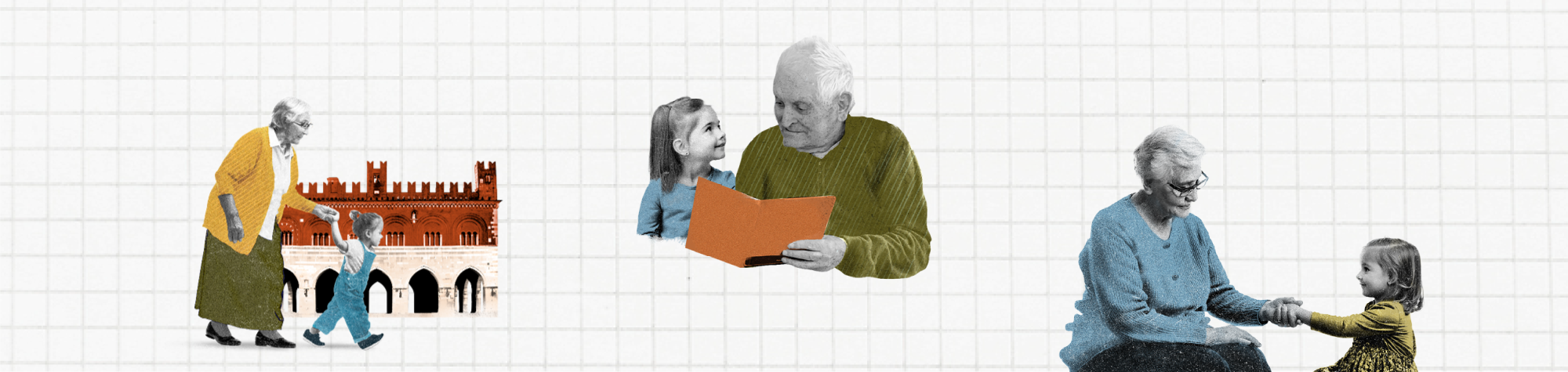
In Italy, the progressive ageing of the population and the decline in the number of children are profoundly reshaping the social fabric, making interactions between generations increasingly rare. The project Anziani e Bambini Insieme (“Older People and Children Together”, ABI), launched in Piacenza 15 years ago thanks to Unicoop, seeks to reverse this trend through an innovative model that integrates elderly care with early childhood education.
The ABI Centre, unique of its kind in Italy, brings together in the same building a nursery school, a daytime care centre for non-self-sufficient older adults, and a residential home for self-sufficient elderly people. Here, children and older adults take part in a wide range of shared activities, including creative workshops, movement and motor-skills sessions, experiences in a vegetable and sensory garden, and everyday moments such as meals and reading time. These interactions not only encourage socialisation, but also provide physical, psychological and cognitive benefits for both elderly people and children.
Fondazione Agnelli, together with Roma Tre University and Unicoop, conducted an in-depth study to analyse the project’s outcomes and identify its strengths with a view to possible replication elsewhere. Coordinated by doctoral researcher Giulia Scarpelli and supervised by Professor Cinzia Angelini, the research highlights the educational and social value of the ABI model and identifies key conditions for its implementation in other contexts.
Benefits and Future Perspectives
Research has shown that intergenerational contact helps children overcome stereotypes about ageing, while older adults regain self-esteem and a renewed sense of purpose. This exchange enriches both groups and contributes to the creation of broader social connections, benefiting families and the wider local community as well.
Conditions for Replication
Among the key factors behind the success of the ABI model are the initial quality of services, staff training, the design of suitable spaces, and the continuous monitoring of activities. The intergenerational approach must become an integral part of the organisational structure of services, moving beyond occasional or isolated initiatives.
The ABI model demonstrates how encounters between generations can provide meaningful responses to social change by enhancing human and social resources. It is a concrete experience that offers valuable insights for rethinking educational and care services in a more inclusive and collaborative way.